The Short Answer
Impact play is a consensual kink in which one partner strikes another, by hand or with tools such as paddles and floggers, to create sensation, release or a focused headspace. Safe impact play stays on well-padded areas like the buttocks and thighs, starts with a warm-up, builds gradually, and stops the moment a safeword is used.
Impact play covers everything from a light, playful hand spanking to a carefully built flogging scene, which is why it is one of the most popular forms of sensation-based kink.
This guide is for consenting adults who are curious about it or planning a first scene with a partner.
It explains the common tools and how each one feels, the body zones that are safe and the ones that are off-limits, why a warm-up matters, how to raise intensity without overshooting, and how to handle negotiation, safewords and aftercare.
A short section also looks at how some people explore the fantasy side through adult AI roleplay before trying anything physical.
The safety advice follows the principles shared across kink education (padded zones, gradual escalation, ongoing consent and aftercare), and it never replaces a real partner's agreement or a doctor's advice.
What Is Impact Play?
Impact play is the consensual use of striking, slapping or hitting a partner's body to create stimulating, erotic or cathartic sensation. Impact play belongs to the sadomasochism side of kink, but nobody has to identify as a sadist or masochist to enjoy it.
Many people are drawn to the sting, the rhythm, the sound, or the focused headspace that controlled impact produces.
The person giving the strikes is usually called the top and the person receiving them the bottom. Those labels describe the activity only. They don't imply a wider dominant or submissive relationship, although many couples fold impact play into one.
Sensation sits on a wide spectrum, from a teasing swat over clothing to a long, carefully escalated scene that the bottom may experience as release or even euphoria. Practitioners usually sort it into two feels:
- Thuddy: a deep, dull pressure that spreads through the muscle, typical of a heavy paddle or a flogger with thick falls.
- Stingy: a sharp, surface-level bite, typical of a cane, a crop or a thin slapper.
Knowing which feel a partner prefers is one of the first things to negotiate. Impact play shares the safety culture of wider BDSM: it is negotiated in advance, agreed to enthusiastically and stoppable at any moment.
That consent, not the action itself, is what separates an erotic spanking from violence.
What Tools Are Used in Impact Play?
Impact play needs nothing more than an open hand, but paddles, floggers, crops and canes each change the sensation through their surface area, weight, flexibility and material. A broad, heavy tool spreads force into a thud; a narrow, light one concentrates it into a sting.
| Tool | Typical sensation | Beginner notes |
|---|---|---|
| Open hand | Adjustable, warm and direct | The best starting point: instant feedback, easy control, no gear. |
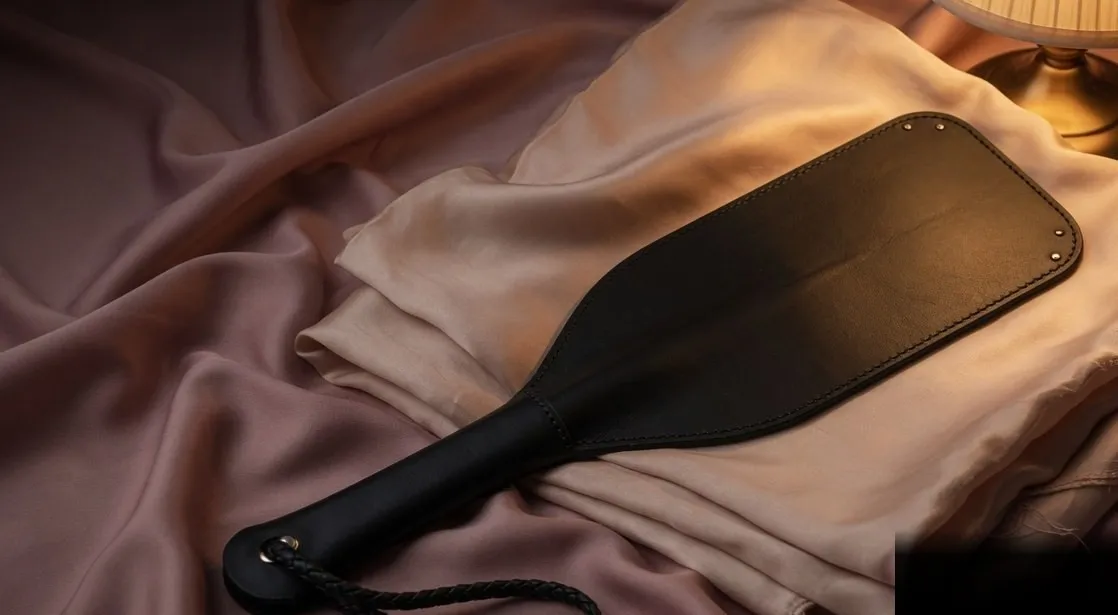
| Paddle | Thuddy to sharp, depending on material | The broad surface spreads force. Leather is mellower; wood and acrylic hit harder. |
| Flogger | Thuddy when heavy, stingy when thin | The falls (strands) vary a lot, and aiming takes practice. |
| Crop | Sharp, focused sting | The small tip means precise placement is essential. |
| Cane | Intense and very stingy | An advanced tool that can break skin. Not for beginners. |
Start with your hand. A hand gives the clearest moment-to-moment feedback, because you feel exactly how hard each strike lands, and it removes the risk of misjudging an unfamiliar implement.
When you do add a tool, test it on your own thigh or forearm first to learn its weight and reach before it touches your partner. Save canes and other high-intensity implements until you have built real experience and trust together.
Where Is It Safe to Hit During Impact Play?
The safest impact zones are the fleshy part of the buttocks and the backs of the thighs, because thick muscle and fat cushion the force well away from organs, the spine and joints. Most spanking and paddling, and all beginner play, should stay there.
| Body zone | Rating | Why |
|---|---|---|
| Fleshy, rounded part of the buttocks; backs of the thighs | Safest | Well padded and tolerant of repeated impact. The default target. |
| Upper back (shoulder blades) and calves | Caution and skill | Less padding, so accuracy matters. |
| Chest | Experienced tops only | Less padding and needs precise control. |
| Lower back and kidneys, spine and tailbone, neck and throat, head, joints, front of the body over organs | Never | Striking these areas risks serious injury. |
A reliable rule of thumb: if you can feel bone close to the surface, don't strike there. The kidneys deserve special mention.
They sit in the lower back just above the hips, they are a common accidental target during enthusiastic spanking, and hard blows can genuinely damage them.
Aim low and central on the buttocks, keep every strike deliberate, and slow down whenever you're unsure of your aim. Accuracy is a safety skill, not a performance flourish.
Why Does Warming Up Matter in Impact Play?
Warming up, which means opening with light contact and increasing force slowly, lets skin and muscle tolerate far more sensation with less bruising and less risk than skin struck hard from cold.
A warm-up also gives the bottom time to settle into the scene and gives the top a chance to calibrate to real reactions before any serious intensity begins.
- Start with touch. Rub, stroke or lightly tap the target area with an open hand to bring blood to the surface and signal what's coming.
- Add very light strikes. Begin far below the level either of you expects to enjoy, almost teasingly soft, and let the bottom feel the rhythm.
- Increase in small steps. Build force over minutes rather than seconds, checking in as you go.
Skipping the warm-up is one of the most common beginner mistakes. It is the fastest route to unwanted bruising, a startled or overwhelmed partner, and a scene that ends early.
For many people the warm-up isn't a delay before the real thing; it's part of what makes impact play enjoyable, so patience pays off in both safety and pleasure.
How Do You Build Intensity Safely?
Safe escalation happens in small, readable stages, with the top controlling the pace and the bottom free to slow or stop the scene at any moment. Good impact play is a feedback loop, not a one-way performance.
- Step up, don't leap. Raise force, speed or tool intensity gradually. Sudden jumps can shock the body and break trust.
- Watch the skin and the breathing. A warm pink flush is normal. Deep purple bruising, broken skin or any whitening means you've gone too far. Tense, held breath often means the bottom is enduring rather than enjoying, which is a cue to check in.
- Vary the sensation. Mixing strikes with stroking, pauses or a change of tool keeps the scene dynamic and gives the body small recoveries.
- Stay sober and present. Alcohol and other impairment dull both judgment and pain feedback, which is dangerous on both sides of the strike.
Intense, sustained impact can shift the bottom into a floaty, altered state often called subspace. The state can feel wonderful, but it also dulls the sense of pain and time, so the bottom may not register that they've had enough.
When a partner is that deep, the top carries more responsibility: pace conservatively, watch the body, and check in proactively instead of waiting to hear a safeword.
How Do You Negotiate Consent and Safewords for Impact Play?
Every impact scene should begin with an explicit conversation about limits and an agreed safeword, before the first strike. Impact play deliberately creates sensation that would be unwelcome in any other context, so clear, enthusiastic consent is what makes it ethical.
The conversation doesn't have to be clinical, but it does have to happen.
- What's on and off the table: tools, body zones, intensity, hard limits (absolute no-gos) and soft limits (maybes).
- Marks: whether visible bruising is acceptable, which matters if a partner has a job, a shared home or another reason to avoid marks.
- Health flags: relevant conditions, areas to avoid entirely, and medications such as blood thinners, which increase bruising.
- Safeword and check-ins: the widely used traffic-light system works well, with green to keep going, yellow to ease off or check in, and red to stop immediately.
If the bottom may be gagged or unable to speak, agree on a physical signal instead, such as dropping a held object. A safeword that can't be heard or honoured isn't a safeword.
Consent is also ongoing: it can be withdrawn at any point, and the top's job is to stop instantly, every time. Anyone who treats negotiation as optional or ignores a safeword has crossed from impact play into harm.
What Aftercare Does Impact Play Need?
Aftercare for impact play means soothing the skin, helping both partners come down from the adrenaline, and checking marks for anything beyond ordinary bruising.
The adrenaline-and-endorphin high of a scene can be followed by a comedown, often called drop, that leaves either partner tired, tender or emotionally vulnerable hours or even a day later. Agreeing on aftercare during negotiation means nobody is left alone with that.
- Skin care: gentle touch, a cool or warm compress and lotion. Clean and cover any broken skin.
- Grounding: a blanket, water, a snack and quiet closeness help the nervous system settle.
- Debrief: reassurance and a calm chat about what felt good and what to adjust next time. The top needs care too.
Some bruising is normal and usually fades within one to two weeks; thorough warm-ups, slow escalation and padded zones keep it to a minimum.
Seek medical attention for anything beyond ordinary marks: severe or rapidly spreading swelling, numbness or tingling, blood in the urine (a possible warning sign of kidney injury), difficulty breathing, or any injury that doesn't look or feel right.
There is no need for embarrassment at a clinic; a brief, honest explanation is all a clinician needs.
Can AI Roleplay Help You Explore Impact Play?
Adult AI roleplay can help you explore the fantasy side of impact play, learn its vocabulary and rehearse the negotiation, but it can't teach the physical skill.
Aim, force and reading a partner's body only develop with a real, consenting partner and the safety precautions above.
Where AI earns its place is before anything physical happens.
Writing a scene lets you notice what actually appeals to you, whether that's the anticipation, the ritual of getting into position, the contrast between thud and sting, or the power dynamic, and put words to it.
On a character-chat platform such as Janitor AI, character creation includes personality, backstory, scenario and example-message fields, so you can set up a top or bottom who treats negotiation and check-ins as part of the story.
Janitor AI also has lorebooks, persistent facts the AI always knows, which are a sensible place to record limits such as "no marks" or "stop the scene on red".
| AI roleplay can help with | Only a real partner can give you |
|---|---|
| Learning terms like top, bottom, thuddy and stingy in context | Safe aim on padded zones, learned through practice |
| Working out why impact appeals to you | Feedback from real skin, breathing and reactions |
| Rehearsing how you'll ask for a scene and state limits | Consent from the person you'll actually play with |
| Imagining how a scene opens, builds and ends | Physical and emotional aftercare |
Content rules differ by platform. Janitor AI doesn't filter what the model generates, so what is allowed depends on the model you connect, while mainstream companion apps are stricter.
Whichever app you use, keep roleplay to adults and fictional characters, and never use a real person's likeness.
Frequently Asked Questions
Impact play is low-risk when partners stick to padded areas, warm up, escalate slowly and honour safewords. Most injuries come from poor aim, especially near the kidneys, from skipping the warm-up, or from ignoring a partner's signals, rather than from the activity itself.
An open hand is the best first tool because you can feel exactly how hard each strike lands and adjust instantly.
Once you're both comfortable, a leather paddle is a mellower next step than wood or acrylic, and canes should wait until you have real experience.
Thuddy impact is a deep, dull pressure felt in the muscle, produced by broad or heavy tools such as paddles and thick floggers. Stingy impact is a sharp, surface-level sensation from narrow or light tools such as canes and crops. Most people prefer one, so ask.
No. Plenty of people enjoy the warmth, rhythm, sound and headspace of light impact far more than any sharp sensation. The people involved set the intensity, and a scene built entirely around gentle spanking is just as valid as a heavy flogging.
Ordinary bruising from impact play usually fades within one to two weeks. Blood thinners and some health conditions make bruising heavier, so mention them during negotiation. Swelling that keeps spreading, numbness or blood in the urine are not ordinary marks and need medical attention.
Not exactly. A spanking kink is one specific and very common form of impact play, focused on spanking the buttocks by hand or with an implement. Impact play is the wider family, which also includes flogging, paddling, cropping and caning on other padded areas.
Wrapping Up
Impact play done well is a conversation in sensation: the top and the bottom stay tuned to each other from the first light tap to the final check-in. The core skills are simple and non-negotiable.
Strike only padded zones, warm up, build intensity in stages, stay sober, and stop the instant a safeword is used. Communication is what makes a scene both safe and satisfying, and the most respected tops are the ones who ask the most questions.
Start light, plan your aftercare, and give yourself time to learn what you actually enjoy. If hand spanking is where you want to begin, our guide to what a spanking kink is covers it step by step.