The Short Answer
A safeword is a pre-agreed word or signal that any partner can use to pause or stop a scene immediately, with no questions asked. Partners choose a neutral word, such as 'red', that would never come up in role-play. The traffic-light system adds 'yellow' for slow down and 'green' for keep going. Honoring it instantly is non-negotiable.
Safewords exist because consensual kink often blurs ordinary language: in role-play, 'no' or 'stop' can be part of the script, so partners agree on a separate signal that always means stop.
This page is for adults new to power exchange, restraint, sensation play, or rougher play, and for readers who first met these ideas in AI roleplay and want to know how they work between real partners.
It covers the traffic-light system, how to choose a word, non-verbal signals for when someone cannot speak, what to do after a safeword is called, the mistakes that quietly break the system, and how to set limits in AI roleplay.
The advice reflects widely shared community practice, and it rests on one principle: consent can be withdrawn at any moment, so the brakes must always work.
What Is a Safeword?
A safeword is a pre-agreed word or signal that immediately pauses or stops a scene, and everyone involved agrees in advance to honor it without debate.
Safewords exist because consensual kink and BDSM often blur ordinary language: a partner might say 'no' or 'stop' as part of a role-play while still wanting the scene to continue. A safeword sits outside that script as a dedicated emergency brake.
Choosing a safeword is not a prediction that something will go wrong. The point is to guarantee that, if anyone reaches a physical or emotional limit, there is a frictionless way to say so.
That guarantee is what lets people relax into intense experiences. Knowing the brakes are reliable allows partners to approach an edge with confidence rather than anxiety.
Safewords are one of the safety frameworks that separate kink from harm, alongside negotiation and aftercare. The thread running through all of them is consent that can be withdrawn at any moment, and the safeword is the mechanism that makes withdrawal instant.
For the wider picture of how these pieces fit together, see our guide to what BDSM is.
Why Does Every Scene Need a Safeword?
Every scene needs a safeword because consent in kink is ongoing and revocable, not a one-time agreement made at the start. People discover limits in real time.
Something that sounded exciting during negotiation can feel different in the moment, and a safeword lets that change be communicated immediately rather than after harm is done.
Ordinary words like 'no' and 'stop' are unreliable inside a scene for three practical reasons:
- Role-play overrides ordinary words. A submissive partner may say 'stop, please' as part of the fantasy. Without a separate safeword, the other partner cannot tell genuine distress from scripted resistance.
- Headspace changes communication. Deep arousal, adrenaline, or a floaty, submissive state can make it hard to form clear sentences. One memorized word is far easier to reach for than an explanation.
- Limits move during play. Bodies and emotions shift. A safeword turns 'I have reached my limit' into a single word that cannot be mistaken for part of the scene.
The rule is simple: any scene with restraint, power exchange, intensity, or role-play should have a safeword. Even mild play benefits from one, because building the habit early means the brakes are already in place when play becomes more intense.
A scene without an agreed way to stop is not consensual play; it is a gamble.
How Does the Traffic-Light Safeword System Work?
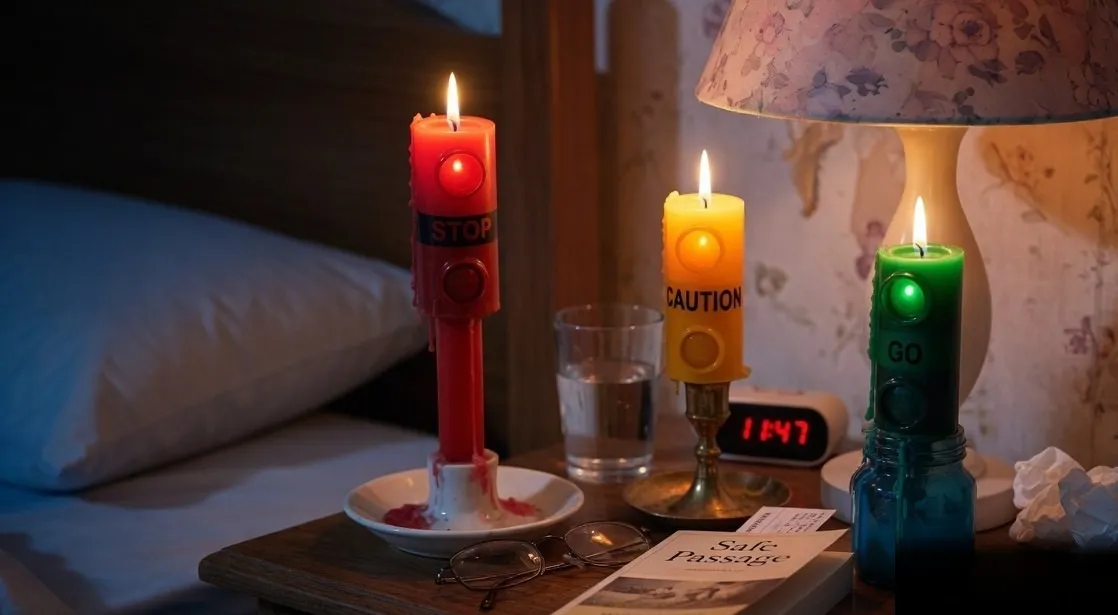
The traffic-light system is the most widely used safeword method: green means keep going, yellow means slow down or check in, and red means stop immediately. Its strength is that it does more than end a scene.
The three colors give partners a shared vocabulary for checking intensity along the way.
| Signal | Meaning | What the other partner does |
|---|---|---|
| Green | Everything is good, keep going. | Continue, and feel free to build intensity. |
| Yellow | Slow down, ease off, or check in; a limit is approaching. | Reduce intensity, pause, or ask what is needed. Do not escalate. |
| Red | Stop immediately. Full stop, end of scene. | Stop all activity at once, release restraints, and move into care. |
Yellow is what makes the system so useful for beginners. Instead of forcing a choice between carrying on and ending everything, it offers a middle gear, a way to say 'I am near my edge, ease up' without halting the experience.
That keeps communication flowing and reduces the pressure some people feel to push through discomfort just to avoid stopping the scene.
Many partners pair the colors with active check-ins. The leading partner asks 'color?' from time to time, and the other answers green, yellow, or red.
Regular check-ins are especially valuable during longer scenes, when trying something new, or with a partner you are still getting to know.
How Do You Choose a Good Safeword?
A good safeword is short, easy to remember under stress, and impossible to confuse with anything that might be said naturally during play. Whether you use the traffic-light colors or a custom word, a few simple rules make for a reliable choice:
- Pick something you would never say in a scene. Words like 'pineapple', 'unicorn', or 'red' stand out because they have nothing to do with the moment. Avoid 'no', 'stop', or 'wait', which may be part of the role-play.
- Keep it short. In a deep headspace, a single clear word is far easier to reach for than a phrase.
- Make sure everyone knows it. A safeword chosen by one person and forgotten by the other is useless. Confirm it out loud before play begins, every time.
- Consider a tiered set. Many people layer a custom stop word on top of the traffic-light colors, giving both a clear emergency brake and a way to dial intensity up or down.
There is no single correct safeword. The best one is whichever word you and your partner will both reliably recognize and honor.
Some couples keep the same safeword across all their play so it becomes second nature; others adjust it per partner or per type of scene. What matters is that it is agreed in advance and never ambiguous.
With someone new, settling on the safeword belongs in the pre-scene conversation, alongside hard limits, soft limits, and aftercare. Our guide on how to talk to your partner about kink helps with starting that conversation.
What If You Can't Speak? Non-Verbal Safewords
A non-verbal safeword is a physical signal, such as dropping a held object or tapping out, that means the same as 'red' when a partner cannot speak.
Scenes can involve gags, mouth coverings, or hoods, and some moments leave a partner too overwhelmed to talk clearly. A safeword that cannot be communicated is not a safeword at all, so partners agree on a backup signal before play begins.
Common non-verbal safe signals include:
- The safe drop. The restrained partner holds a small item, such as keys, a ball, or a scarf, and drops it to signal stop. Dropping something is easy even when the wrists are bound.
- A tap-out. A clear, agreed pattern, such as three firm taps on the partner's body or a nearby surface, borrowed from tapping out in grappling sports.
- A distinct sound. A specific hummed pattern, a series of grunts, or a small bell or buzzer within reach.
Whatever signal you choose, the leading partner takes on extra responsibility to watch and listen for it continuously. If someone is gagged or restrained, you do not get to disappear into your own experience; staying attentive to the safe signal is part of the job.
Use eye contact or a squeeze-back system ('squeeze my hand twice if you are okay') so that a lack of response itself becomes a warning sign.
What Happens After a Safeword Is Used?
When a safeword is called, the scene stops fully and immediately, without negotiation or judgment. Stopping means ending the activity, releasing any restraints, removing gags or blindfolds, and giving your full attention to the person who called it.
There is no 'just one more' and no asking them to justify the call. Honoring the word the instant it is spoken is what makes the whole system trustworthy.
After stopping, move straight into aftercare: the deliberate attention partners give each other to return to a calm, grounded baseline. Common forms include:
- Physical comfort: water, a blanket, a snack, gentle touch, or simply sitting together quietly.
- Emotional reassurance: calm, kind words and confirmation that calling the safeword was the right thing to do.
- A gentle check-in later: once everyone is settled, a low-pressure conversation about what prompted the stop and what to adjust next time.
A called safeword should never be treated as a failure or a disappointment. Framing it that way pressures people to stay silent when they most need to speak up, which is the opposite of safe.
A partner who uses their safeword did exactly the right thing by communicating a limit clearly, so thank them for it. Over time, that response builds the trust that makes both partners more honest and more able to explore.
What Are the Most Common Safeword Mistakes?
The most common safeword mistakes are not agreeing on one, choosing a word that fits the role-play, and responding slowly when it is called. Each is easy to avoid once you know to look for it.
- Not agreeing on one at all. Assuming 'we will just know' is the biggest mistake. Set the safeword explicitly before every scene, even a familiar one.
- Using a word that fits the role-play. If the safeword could plausibly be said as part of the scene, it cannot do its job. Keep it neutral.
- Ignoring or delaying the response. Pausing only 'after this part' is not honoring a safeword. Stop the instant it is called.
- Forgetting a non-verbal backup. Any gag, hood, or deep restraint scene needs a physical signal agreed in advance.
- Treating it as a failure. Sulking or guilt-tripping after a safeword teaches a partner to stay quiet next time.
- Mixing substances with play. Alcohol and drugs blur judgment and slow reactions, making a safeword harder to call and to recognize.
Get these right and the safeword does exactly what it is meant to do: it stays in the background, unused most of the time, but always ready the moment it is needed.
Can You Use a Safeword in AI Roleplay?
You can use a safeword-style stop signal in AI roleplay, but it works differently from one between people: an AI character cannot be hurt, so the signal exists to protect you and keep the story inside limits you chose.
Many adults first meet power-exchange themes in AI roleplay chat, and setting limits there is useful practice for the real conversation with a partner later.
A simple setup that suits most character-chat apps:
- Write your limits into the character description. The character creator on Janitor AI has fields for personality, backstory, scenario, and example messages. A line such as "If the user types 'red', the character stops the scene and checks in" gives the model a rule to follow, and Janitor AI's lorebooks hold persistent facts the AI keeps in view.
- Use an out-of-character note. A common text-roleplay convention is to step outside the story with a bracketed note, such as "(OOC: let's stop here and change the scene)". Use it the moment a thread drifts somewhere you don't want.
- List hard limits up front. Put off-limits topics in the scenario so the character never raises them. On SpicyChat AI, you can build a character with its own personality, scenario, and greeting and keep it private.
- End the session if the rule is ignored. Closing the chat is always an option.
Two caveats matter. Results depend on the model: our Janitor AI review found that output quality varies with the character and model you use, so a stop rule may not be followed perfectly every time.
And rehearsing with an AI is not negotiating with a person. A real safeword relies on a partner who watches, listens, and stops.
Keep characters fictional and adult; SpicyChat AI's content policy prohibits content involving minors and real-person impersonation.
Frequently Asked Questions
Red is the most widely used safeword, usually as part of the traffic-light system alongside yellow and green. Because colors are easy to recall under stress, many partners rely on them even when they also keep a custom word for emergencies.
Only if your play never includes scripted resistance. Many scenes do, which makes 'no' and 'stop' ambiguous and forces a partner to guess. A neutral word with no place in the scene removes that doubt and keeps the stop signal unmistakable.
Agree on a physical signal before play starts, such as dropping a held object, a set pattern of taps, or a distinct sound.
The partner in control watches for it the whole time and treats any missed response to a check-in as a reason to pause.
No. A safeword helps in any intense, rough, or role-play-heavy intimacy between consenting adults, including sensation play and emotionally charged scenarios. Whenever the word 'stop' could be mistaken for part of the moment, a dedicated signal keeps consent clear for everyone.
No. A called safeword means communication worked. Stop, offer comfort, and talk once everyone feels settled. Partners can reconnect with something gentler or revisit the idea another day with adjusted limits. What damages trust is sulking or pressure afterward, never the safeword itself.
Raise it in the pre-scene conversation, alongside likes, limits, and aftercare. Something as simple as 'red means stop and yellow means slow down, does that work for you?' is enough. Then confirm it out loud before every scene, even with a partner you know well.
Wrapping Up
A safeword is the simplest safety tool in consensual kink: an agreed signal that lets anyone stop the moment they need to.
The traffic-light system gives partners a shared vocabulary for checking in and stopping, and a non-verbal backup keeps the brakes working when speaking isn't possible. A safeword that isn't honored instantly, completely, and without judgment is not a safeword at all.
Agree on yours before you start, respect it every time, and plan how you'll wind down together afterward. Our guide to aftercare in BDSM covers that next step.